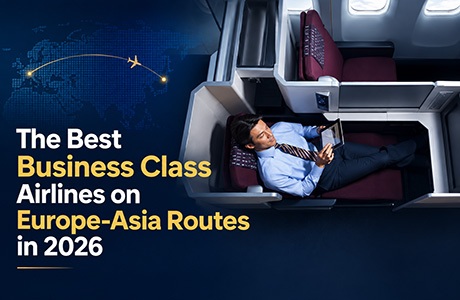
Flying in Business Class
Business Class is a travel class above Economy and Premium Economy, and it is the highest class available on many flights that do not offer First Class. It offers more space, greater comfort, priority services, and, especially on long-haul flights, seats that usually convert into fully flat beds, plus much more.
Until about twenty years ago, it was considered a privilege reserved for the wealthy and business travelers, or at most an expensive treat for couples on their honeymoon. Nowadays, however, it is all much more accessible. Prices change frequently thanks to dedicated pricing algorithms, so you can use technology to find great deals. And with a few tricks of the trade, you can secure your premium seat for only a little more than the price of Economy.
In this article, we will look at the benefits of Business Class and how you can enjoy them without spending a fortune.
Before and After the Flight
The benefits go beyond in-flight comfort, and a Business Class ticket usually includes:
- Dedicated check-in counter
- Priority boarding
- Priority security screening at selected airports
- More generous baggage allowance
- Complimentary access to airport lounges
- Priority baggage handling upon arrival
Airport lounges may offer meals, drinks, Wi-Fi, showers, relaxation areas, and workspaces. Not all Business Class fares necessarily include lounge access. Some airlines offer “Business Light” fares, but lounge access is included in most cases.
On Board
Short Flights
On short-haul continental flights operated by smaller aircraft, Business Class often uses the same seats as Economy, but with the adjacent seat left empty and a curtain separating the front rows from the rest of the cabin. In this case, the main benefits are:
- Greater peace and quiet
- More space with the adjacent seat left empty
- Meal and beverage service
- Airport priority services
- Increased baggage allowance
- Lounge access
Very often, it is essentially Economy dressed up very nicely, but the seat itself is identical. In other cases, there is a dedicated cabin complete with beds, but realistically, it does not make much sense to buy a Business Class ticket for a one- or two-hour flight, especially if you are going on vacation and do not absolutely need that time to work or sleep. However, if your intercontinental flight includes a connecting short-haul leg operated by a smaller aircraft, you will most likely find yourself in this situation, which is still a nice little extra treat.
Intercontinental flights
On long-haul flights, the difference is much more noticeable and substantial:
- Wider, fully adjustable seat that reclines 180 degrees into a completely flat bed.
- Various storage compartments and surfaces to keep your belongings within easy reach.
- more privacy
- Larger personal entertainment screen
- electrical outlets and USB ports
- Travel amenity kit
- Pillow, blanket, and bed linen
- Multi-course meals
- Wines, champagne, and premium beverages
- Direct aisle access*
The best configurations are generally 1-2-1, as every passenger has direct aisle access. *With 2-2-2 or similar configurations, you may have to climb over another passenger to reach the aisle.
Types of Seats
Recliner: A wide, reclining seat that does not convert into a bed. Common on short-haul flights.
Angled-flat: Almost flat, but slightly angled. Less comfortable for sleeping.
Lie-flat: Reclines into a completely flat bed. The standard on long-haul flights.
Suite con porta: Offers greater privacy, but does not automatically mean better seating or service.
Meals and Service
Business Class service normally includes more elaborate meals than Economy, with a choice of different dishes and generally more carefully presented. On some flights, you can order your meals in advance or decide when you want to eat. Sometimes, you can even choose your breakfast before takeoff. You can also indicate that you do not want to be disturbed and would prefer to sleep during meal service.
The quality of meals and service is not directly related to the quality of the seat. An airline may offer an excellent seat but mediocre service, or a less modern seat with an outstanding crew and excellent food.
Baggage
Business Class generally includes:
- One or two pieces of checked baggage
- A higher weight allowance
- Two carry-on bags + one personal item (such as a handbag or laptop bag)
- Priority Delivery Upon Arrival
The specific rules depend on the airline, the route, and the fare purchased.
How much does it cost?
The base fare can be anywhere from two to ten times the price of Economy. There are many factors involved:
- Route
- travel period
- reservation deposit
- Flight duration
- stopovers
- airline
- ticket flexibility
- offers
- departure airport
A cheaper Business Class ticket is not necessarily worse: it may simply involve a less convenient layover, a non-refundable fare, or a special offer.
How to Spend Less
The most common “tricks” for getting a Business Class ticket without spending too much are:
- Be flexible with travel dates and airports.
- checking prices every day
- Book well in advance.
- Compare different outbound and return flight combinations.
- Sign up for airline newsletters and keep an eye on special offers.
- Use frequent flyer status, miles, or points to reduce the cost of your ticket.
Other alternative methods:
- Book Business Class for the outbound flight only.
- Check for upgrade offers (sometimes it is cheaper to book Economy and then upgrade to a higher class).
- Participate in upgrade auctions (the same idea as a standard upgrade: you place a bid, and if it is accepted, you fly in a higher class for relatively little extra cost, although there is no guarantee of success).
- Choose flights with one or more layovers. Sometimes this can be a good way to save money, but inconvenient or excessively long layovers often outweigh the benefits.
Last-minute upgrades can be a good deal if there are still seats available in Business Class at boarding time, but you will have to leave everything to chance. Also, some upgrade offers do not earn the same miles or include the same benefits as a regular Business Class ticket.
The main differences between the premium travel classes:
Premium Economy: A step below Business Class, but not always that far behind in terms of comfort and service. Compared with Economy, it offers wider seats, more legroom, and better service, but it does not provide a bed or the same level of privacy as the higher class.
Business Class: Designed for sleeping, working, and traveling comfortably on long-haul flights. It generally offers good privacy and more personal space, as well as a range of benefits on the ground.
First class: The ultimate travel class, not available on every aircraft. It offers even more space, complete privacy, and personalized service. However, a good modern Business Class can offer better value for money without being too far behind First Class in terms of comfort.
Various prices
Business Light, Classic, and Flex: What’s the Difference?
Buying a Business Class ticket does not necessarily mean getting all the services traditionally associated with this category. Many airlines have introduced different fare categories, often with names such as Light, Classic, Standard, or Flex. The names may vary, but the principle remains the same: the seat on board is similar, while the ticket conditions and included benefits differ.
Business Light is generally the cheapest option. It allows you to travel in the premium cabin, but may exclude certain services, such as lounge access, free seat selection, checked baggage, or the option to change or refund your ticket. In some cases, it may also earn fewer miles than a standard Business Class fare. It can be a good deal if you are mainly interested in onboard comfort, but you should check whether the savings are actually worthwhile.
Classic or Standard Fares usually include most Business Class benefits, such as baggage allowance, airport priority services, lounge access, and seat selection. However, they may still involve change fees or fairly restrictive refund conditions.
Business Flex, on the other hand, is designed for travelers who need greater flexibility. It usually allows you to change your flight with reduced or no change fees and offers more favorable cancellation terms. It is particularly useful for business trips or when your travel dates are not yet confirmed, but it may be unnecessary for a vacation that is already fully planned.
Before choosing the cheapest fare, it is worth calculating the total cost of your trip. If you have to pay separately for baggage, seat selection, or lounge access, the price difference compared with the higher fare may become considerably smaller.
How to Choose a Good Flight
Checking the airline’s name is not enough. You should also look at other details:
- aircraft model
- cab configuration
- Availability of a true lie-flat seat.
- direct access to aisle
- Rates and Terms
- Ground services and benefits
If your flight includes one or more layovers, it is also important to check:
- length of the stopover
- airport used
- Lounge access
The same airline may use different Business Class configurations on different routes.
Best seats
For solo travelers, individual window seats, when available, generally offer greater privacy. On some aircraft, however, other seats may provide more privacy and space. For couples, the two center seats are often more convenient for chatting and spending time together.
Avoid, whenever possible:
- Seats near the toilets and galley
- Seats exposed to frequent crew traffic
- Front-row seats if storage space for personal belongings is limited.
- Seats without direct aisle access.
Reality vs. Expectations
Business Class is generally an excellent choice, but it does not always guarantee:
- A fully flat and comfortable bed
- privacy
- Fast service
- Excellent meals
- Free Wi-Fi
- A high-quality airport lounge
- Better punctuality or protection in case of delays
Furthermore, an aircraft change may mean that the seat you originally booked is replaced with an inferior product. These situations are fairly rare when flying with certain airlines, such as those in the Lufthansa Group, but are quite common with others, such as Qatar Airways. This simply means that you may not get Qatar Airways’ best product on that particular flight, not that Qatar Airways is inferior to SWISS, since even Qatar’s older cabins are comparable to their SWISS counterparts.
When Is It Really Worth It?
Flying Business Class is always nice, but it is particularly worthwhile when:
- The flight lasts ten hours or more.
- You need to work and require space and privacy.
- You are traveling overnight and want to arrive at your destination well-rested.
- You have a very long layover and want to “camp out in the lounge” while you wait.
- You are traveling with a lot of luggage.
- Comfort is more important than price.
- You find a good deal or have miles and frequent flyer status to use for an upgrade.
On a short-haul flight lasting one or two hours, the practical difference between Economy and Business Class is very small. The main benefits are the ground services, and it is often not worth the extra cost.
On an intercontinental flight lasting more than ten hours, especially an overnight one, having a bed, a quieter cabin, a better entertainment system, higher-quality meals, and good privacy can completely change your perception of the journey, turning the flight from a “necessary evil” into an “enjoyable experience.”
Personally, until a few years ago, I almost always flew Economy, even on longer trips, often taking advantage of a few simple tricks and tips to make the journey more comfortable at very little extra cost. You can find the dedicated article here: Flying in comfort: the best seats in Economy
Then one day, while comparing prices, I found a Premium Economy flight that cost just €100 more, so I took advantage of it. That experience made me realize it was not a coincidence or a pricing error. Fares can fluctuate considerably, and sometimes the difference in total cost can be surprisingly small. So I started booking my flights and looking for good upgrade deals in Premium Economy, and I discovered that, in some cases and with certain airlines, even though it is not the ultimate luxury, it can significantly improve the flying experience compared with regular Economy.
The same thing happened with Business Class. I have always been relatively poor (and still am ^^), so every time I walked through the Business Class cabin on my way to the back of the plane, I would think how nice it would be to fly lying down on a bed instead of being crammed into a seat, fighting with the passenger next to me over the armrest. And so, while searching for yet another flight to Bangkok, my eyes landed on a Florence-Zurich-Bangkok flight with SWISS that cost just €300 more in Business Class than in Economy.
After the short flight to Zurich, just over an hour with barely noticeable differences compared with Economy, I was among the first to board the plane to Bangkok, while the crowds were still waiting for their turn at the gate. The overhead compartment was empty, with plenty of room for my two carry-on bags. My seat was nicely separated from the passenger next to me, and beside it I had what looked like a bedside table, complete with compartments and shelves for my belongings. The screen was bigger, the seat even had adjustable firmness, and a partition between the two center seats made everything much more private. They brought me a menu for breakfast the following morning, and while I was deciding whether to stuff myself with cappuccino and croissants or bacon, omelette, and orange juice, eventually choosing both, my seat was massaging my back as the Economy passengers started filing past me. And I felt happy. ^^ In the end, I remember thinking that I had never slept or eaten so well on a plane.
Flying Business Class really is a whole different experience.